
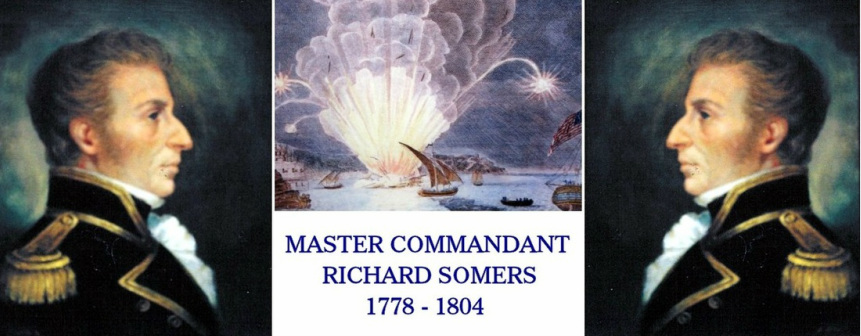
The physical remains of Richard Somers lie in a grave near Tripoli harbor in Libya where he was buried during our war against the Barbary pirates two hundred years ago. Now the residents of New Jersey’s Somers Point, local officials, veterans groups, and Somers’ descendants are calling for the return of their native son and his crew.
Interested community members have formed the Return Richard Somers Committee. The Press of Atlantic City has editorially endorsed the idea, and a member of the Somers family has agreed to donate DNA samples to identify his remains. Congressman Frank LoBiondo (N.J.) has asked the State Department to look into the matter. If you, too, wish to assist the residents in this quest you may join in signing their petition.
Though the United States has no official diplomatic relations with Libya, the situation has changed dramatically over the past few years. A recent thaw in the previously cold relations could lead to the return of Somers and his crew as early as September, 2004, two hundred years after they died during the battle of Tripoli in 1804.
The United States won its first war through the efforts of Somers and Steven Decatur, along with Commodore Edward Preble, Diplomat-warrior William Eaton and Sgt. Presley O’Bannon, USMC. A major motion picture, ”Tripoli,” is now being made of their legendary story of fighting pirates. Unlike its swashbuckling predecessor starring Tyrone Power and Maureen O’Hara, the new movie is said to be a cross between “A Man for All Seasons” and “Lawrence of Arabia.” Russell Crowe stars as William Eaton, the American diplomat who took to the sword and dagger to convince the pirates to capitulate.
After the United States won its independence from England the new Stars and Stripes flying from American merchant ships did not carry the same recognition and weight as the British Union Jack. Even so, the British chose to pay “tribute” to the Barbary pirates to protect their ships. The reluctance of U.S. President Thomas Jefferson to pay such tributes led to the capture of many American ships and the enslavement of their crews.
“Millions for defense, not one cent for tribute!” became the battle cry of the nation that was unprepared for war and had yet to build an adequate navy.
Appalled at the news of the enslaved sailors, the city of Philadelphia built the battleship “Philadelphia,” which was immediately dispatched to confront the pirates and blockade Tripoli harbor. Preble, the newly appointed commander of the fleet, sent Lts. Somers and Decatur in fast schooners. Before they arrived, the USS Philadelphia ran aground on an uncharted reef while chasing a pirate corsair into Tripoli harbor. Captain Bainbridge and his 300-man crew were captured, placing in the hands of the enemy a ship as big and powerful as any in the American fleet.
When Somers and Decatur arrived, they captured a pirate ship where they found the sword of an officer from the Philadelphia. Christened the USS Intrepid, the prize would become one of the most famous ships in the U.S. navy.
After decisively defeating the enemy in a number of skirmishes, Decatur sailed the Intripid into the harbor disguised as an Arab trader. He recaptured and sank the Philadelphia without firing a shot and without any casualties. Then Somers, with a dozen volunteers, reentered the harbor, having filled the Intripid with combustibles. Unfortunately, during the daring nighttime raid the Intrepid prematurely exploded in the harbor. The bodies of Somers and his crew washed ashore the following day and were buried in a nearby cemetery by prisoners from the Philadelphia. An unkempt memorial marks their graves.
The actions of Somers and Decatur helped inspire the line in the Marine Corps anthem “From the Halls of Montezuma to the shores of Tripoli.”
Preble and Decatur proceeded to defeat the pirates at sea, while Eaton and O’Bannon, together with eight marines, 200 Greek mercenaries, and an army of Arab Bedouins, marched across the desert and forced the pirates to surrender. The United States won the war, the prisoners from the USS Philadelphia were release, and no tributes were paid, but the remains of Somers and his crew were left behind.
The Return Richard Somers Committee and the people of Somers Point hope the movie will arouse public interest in the return of Somers and his men, left in Tripoli after the war was won. “The Marines have a tradition of not leaving our dead or wounded behind,” says Nace Benner, former marine and Somers Point native. “We left Somers behind and should bring him home.”
The task is complicated by recent politics. Libya is led by Mohammar Quaddafi, who took power in a military coup in 1969. Quaddafi has actively supported terrorism against the United States. Libyans were implicated in the bombing of the Pan Am flight over Lockerbie, Scotland, as well as in the bombing of a German nightclub that killed U.S. servicemen and civilians. President Reagan retaliated by bombing Quaddafi’s home, killing one of his daughters. An American Navy pilot was shot down in that attack. Like Somers and his crew, his body washed ashore near Tripoli, but his remains were repatriated by Libya.
After espousing terrorism for decades, Quaddafi has made a turnaround. He turned over the two main suspects in the Pan Am bombing, one of whom was convicted and is in prison. The Libyans have also offered millions of dollars in reparations to the families of the Lockerbie victims, on condition that the United States and UN end their economic sanctions against Libya. This suggests that Libyan leaders want to renounce terrorism and rejoin the global community of trading nations. As the Libyan ambassador for the UN has been appointed head of the UN Human Rights Commission, the time for the repatriation of Somers and his crew would seem appropriate.
Former Congressman and U.S. Ambassador to Panama William Hughes, who over twenty years ago sponsored the Congressional resolution to being Richard Somers home, recently said, “The situation has certainly changed, and there is now a window of opportunity that we should take advantage of.”
Preble is now honored by naming the latest ship in the navy the USS Preble. Eaton and Presley will become famous heroes when the movie “Tripoli” is released next summer. Richard Somers and his crew should be honored by bringing them home before the 200th anniversary of their heroic deaths.
by William Kelly [Bill Kelly is author of 300 Years at the Point - A History of Somers Point, N.J.] All rights reserved.
LATEST UPDATES
No Man Left Behind .... Richard Somers T-Shirts, Donations,
Committee goes to Washington,DC
House Resolution HR1497 calls for the repatriation of the remains of Richard Somers and the men of the USS Intrepid from Tripoli.
Contact Committee Members & Additional Resources
American Embassy members at Tripoli Gravesite on Memorial Day 2010. Photos
Somers' Washington Ring Stolen and Recovered by William Kelly
The Somers ring, one of the most legendary relics of the nation’s family jewels... more.
Remarks by William Kelly at the September 4, 2006 anniversary of death of Richard Somers... more.
Chronology – Richard Somers
1778 (9?) – September 15 – Richard Somers, Jr. is born at his father’s home, which still exists as the Somers Manor office building at the corner of Shore and Bethel Roads, Somers Point... more.
Barry, John – Father of U.S. Navy and First Military Academy? - William Kelly
Commodore John Barry, Irish born American Revolutionary naval hero, is generally... more.
A delegation from Somers Point, New Jersey traveled to Washington, DC on Friday April 15, 2011 and met with Congressmen Mike Rogers (R- MI) and Frank Lobiondo (R-NJ) to discuss the recently introduced House Resolution that calls for the repatriation of the remains of Richard Somers and the men of the USS Intrepid from Tripoli.
Sent to fight Barbary pirates, Somers and his 12-man crew perished in the explosion of the Intrepid in Tripoli harbor on September 4, 1804. The men were buried by captured American prisoners from the frigate USS Philadelphia outside the walls of the old castle fort in the Libyan capitol. Remains of five of the men were later uncovered by an Italian road work crew and reburied nearby in marked graves at the Old Protestant Cemetery.
Although numerous efforts to repatriate the remains by the Somers family and citizens of Somers Point have been fruitless over the years, the current turmoil in Libya has called attention to the issue, and there is renewed hope that when the turmoil settles down, the repatriation of the remains of these men will be made a national priority.
Earlier in the week Rogers introduced House Resolution 1497 that was co-sponsored by Lobiondo, which directs the Secretary of Defense "to take whatever steps may be necessary to exhume and transfer the remains of certain deceased members of the Armed Forces buried in Tripoli, Libya, and for other purposes." The discussions centered on the difficult task of generating public support for the resolution and finding more Congressmen to co-sponsor the resolution.
Among those from Somers Point who attended the meeting were Somers Point Mayor Jack Glasser, Historical Society President Sally Hastings, Walter Gregory, chairman of the Committee to Return Richard Somers, committee member Greg Sykora, and Dean Somers, of the Somers family.
Documentary filmmaker Will Kahane and local historian William Kelly and also accompanied the delegation to Washington where they met public relations specialist Michael Caputo, who helped organize the meeting, and Chipp Reid who recently completed a book about the Barbary Wars.
The resolution was sent to the Military and Veterans Affairs Committees for consideration, and needs additional co-sponsors. The group also met with veterans groups and hopes that their support will lead to a committee hearing and house votes in support of the resolution, as well as sponsors in the Senate. The delegation also met with senior staff at the headquarters of the American Legion, one of the nation's largest veterans service organizations. The Legion is considering supporting the effort to repatriate Somers and his crew and agreed to meet the delegation to discuss the issue in detail. "
"The veterans groups are the ones who are going to take this to another level," said Committee member Greg Sykora. Both the Congressmen and the Veterans groups noted the importance of the families. "I would like to have my family member come home," said Dean Somers. "It's time."
Somers Point mayor Jack Glasser was encouraged by the direction of the meetings. "It was very encouraging because we now have direction, and there are important people who want to help us," said Glasser, after meeting with Rogers and LoBiondo. "Hopefully it will pick up momentum and more people we join us."
The meetings also infused new optimism among the members of the Committee to Return Richard Somers. "I have been pessimistic because we have been down so many blind alleys the past seven years," said Committee Chair Walt Gregory. "I think we are now finally moving forward."
"The 200 year old story of Richard Somers isn't over yet," said Sally Hastings of the Historical Society. "It continues today, and discouragement has turned to hope."
For further information contact:
Somers Point Mayor Jack Glasser - (609) 377-4738jglasser07@comcast.net
SPHS President Sally Hastings (609) 927-8002 -sallyhastings2@aol.com
Return Richard Somers Committee Chairman Walt Gregory (609) 513-6219 -Brutusboy6665@aol.com